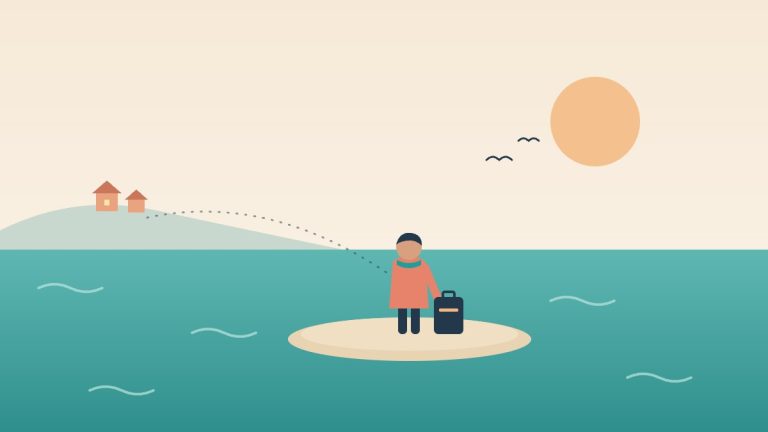

Emigrating is one of the biggest decisions a person can make. You leave behind your family, your language, your habits and, sometimes, the person you used to be. For many people, the change comes with excitement and normal difficulties. For others, the conditions are so harsh that the stress ends up exceeding their ability to adapt.
Psychiatrist Joseba Achotegui gave this second situation a name: Ulysses syndrome. In this article I explain what it is, how to recognise it and what you can do if it sounds familiar.
I have lived in four countries myself. I know what it is like to start from scratch far from home, and in therapy I support many people who are going through that process.
What is Ulysses syndrome?
Ulysses syndrome, or the syndrome of the immigrant with chronic and multiple stress, describes the suffering of people who migrate in extreme conditions. It was described by Joseba Achotegui, a psychiatrist at the University of Barcelona, in the early 2000s, based on his work with migrants.
The name comes from Ulysses, the hero of the Odyssey, who spent years far from his loved ones, facing danger and loneliness without being able to return home.
According to Achotegui, it appears when four major sources of stress build up over months or years:
- Loneliness: forced separation from family, especially when you can neither bring them over nor visit them.
- A sense of failure: when the migration project doesn’t turn out as expected and you can’t see a way out.
- The struggle to survive: difficulty finding housing, work or food.
- Fear: of the dangers of the journey, of deportation, of abuse or of not having papers.
What sets it apart from the usual difficulties of emigrating is the intensity and duration of that stress: there is so much at once, for so long, that there is no room left to grieve what has been lost.
The seven griefs of migration
Every migration involves losses, even when you chose it and things are going well. Achotegui groups them into seven griefs:
- Family and loved ones, usually the most painful.
- Language: no longer being able to express yourself naturally, with nuance and humour.
- Culture: customs, schedules, food, ways of relating to others.
- The land: the landscapes, the light, the climate of your country.
- Social status: you often work below your qualifications, or your degrees are not recognised.
- Belonging: feeling like “the outsider”, sometimes facing prejudice or discrimination.
- Risks to physical safety: dangerous journeys, hard work, illness.
Not every migratory grief is Ulysses syndrome
It is important not to mix things up. Achotegui distinguishes three ways of living through these griefs:
- Simple grief: you migrate in reasonable conditions, you can visit home and the people around you are supportive. There is sadness and homesickness, but you work through them.
- Complicated grief: there are serious difficulties, for example young children or ill parents back home, but there is still some room to be reunited with them or to return.
- Extreme grief: the losses and stress are so great that they cannot be worked through. This is what corresponds to Ulysses syndrome.
If you moved to another country with a job, papers and the option of going back, you are very probably not experiencing Ulysses syndrome. That doesn’t make your distress any less real: a simple or complicated migratory grief can also weigh heavily and deserves attention.
Symptoms of Ulysses syndrome
Symptoms often overlap and change over time. Achotegui groups them into four areas:
- Mood: sadness, wanting to cry, guilt (for having left, for not being able to help your family). Thoughts of death sometimes appear, although they are less frequent.
- Anxiety: constant worry, tension, irritability and insomnia, especially difficulty falling asleep.
- Physical symptoms: tension headaches, tiredness that doesn’t go away, muscle or joint pain.
- Confusional symptoms: memory and attention lapses, feeling lost or disoriented, not feeling like yourself.
An important point: many people with this syndrome keep fighting. They stay motivated and determined to move forward, even when exhausted. That is why their suffering often goes unnoticed, even by themselves.
If at any point you have thoughts of ending your life, don’t wait: call the emergency services of the country you are in (112 throughout the European Union, or your local emergency number).
Is it a mental illness?
No. Achotegui insists that Ulysses syndrome is not a mental disorder, but a stress reaction to an extreme situation. It does not appear as a diagnosis in psychiatric manuals (DSM or ICD). He places it on the border between mental health and psychopathology: it is a warning sign.
This idea has two practical consequences. On the one hand, your distress is not a weakness: it is proportionate to what you are going through. On the other, if the situation continues, the risk of developing a disorder, such as depression, increases. That is why it is worth acting early.
How is it different from depression?
They look alike, but they are not the same. According to Achotegui:
| Ulysses syndrome | Depression | |
|---|---|---|
| Origin | Several extreme stressors at once, over months or years | There is not always a clear external cause |
| Motivation | Usually maintained: the person keeps fighting | Interest in almost everything is often lost |
| Self-esteem | Generally preserved | Often badly damaged |
| Physical and confusional symptoms | Very present | Less central |
This difference is not just theoretical. Mistaking Ulysses syndrome for depression can lead to treating only the symptoms and forgetting what matters most: the situation causing them. That is why it is important to be assessed by a professional, ideally one with experience of migration.
What you can do
Since the syndrome comes from a situation, the first step is to ease that situation as much as possible:
- Take care of the basics: housing, papers, work, health. Migrant support organisations, NGOs and social services can help you far more than you might think.
- Break the isolation: look for other people from your country or who speak your language, and stay in touch with your family, even by video call.
- Look after your body: regular sleep, some movement, regular meals. It sounds small, but it holds a lot together.
- Keep your roots: your music, your recipes, your celebrations. You don’t have to choose between your culture and the new one.
- Name what you have lost: talking or writing about it helps grief move forward instead of getting stuck.
How therapy can help
Therapy doesn’t replace practical help, but it complements it. It helps prevent stress from turning into a disorder and gives you back a little inner space.
In my work, I combine several evidence-based approaches, depending on what you need:
- A clear assessment at the start, sometimes with validated questionnaires, to understand what is happening to you and what isn’t.
- Third-wave CBT, such as Acceptance and Commitment Therapy (ACT) and mindfulness: learning to make room for sadness and fear without letting them paralyse you, and acting again on what matters to you.
- EMDR, when difficult memories of the journey or of what you went through still weigh on the present.
Sessions take place online, in English, French or Spanish, wherever you are. Talking about your experience in your own language, with someone who has also emigrated, makes a big difference.
Frequently asked questions
Who described Ulysses syndrome?
Psychiatrist Joseba Achotegui, of the University of Barcelona, in the early 2000s, based on his clinical work with migrants.
Can it affect an expat living in good conditions?
Strictly speaking, no: Ulysses syndrome refers to migration in extreme conditions. But an expat can experience simple or complicated migratory grief, with sadness, anxiety or culture shock, which also deserves attention.
How long does it last?
It mainly depends on the situation causing it. When the stressors ease and there is support, symptoms usually improve. Insomnia is often the first thing to get better.
Is it treated with medication?
It is not an illness, so the key is to reduce stress and support the grieving process. If there is an associated disorder, such as depression, a doctor will assess whether medication is needed.
Does online therapy work in these cases?
Yes. For many people living far from their country, it is the only way to talk to a psychologist in their own language, and video sessions allow good-quality work.
Shall we talk?
If you recognised yourself in this article, you don’t have to go through this alone. The first contact is free and lasts 20 minutes: you tell me what is going on and we see together how I can help.
Free first contact · Message me on WhatsApp
Gonzalo Garzo, clinical psychologist (registered in France, ADELI 179307913, and with the Official College of Psychologists of Madrid, M-34763), specialising in expatriation and adjustment processes.
Sources (in Spanish)
- Achotegui, J. (2003). La depresión en los inmigrantes extracomunitarios: el síndrome del inmigrante con estrés crónico y múltiple (síndrome de Ulises). Revista Clínica Electrónica en Atención Primaria.
- Achotegui, J. (2006). Estrés límite y salud mental: el síndrome del inmigrante con estrés crónico y múltiple. Migraciones, 19, 59–85.
- Achotegui, J. (2017). El síndrome del inmigrante con estrés crónico y múltiple (síndrome de Ulises). Revista de Menorca, 96, 103–111.