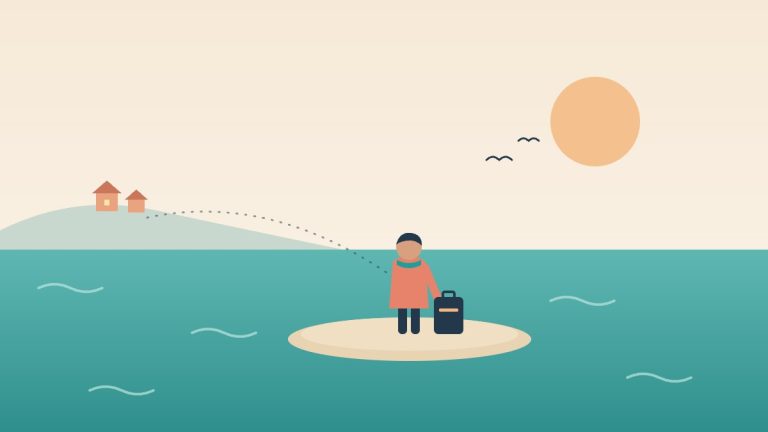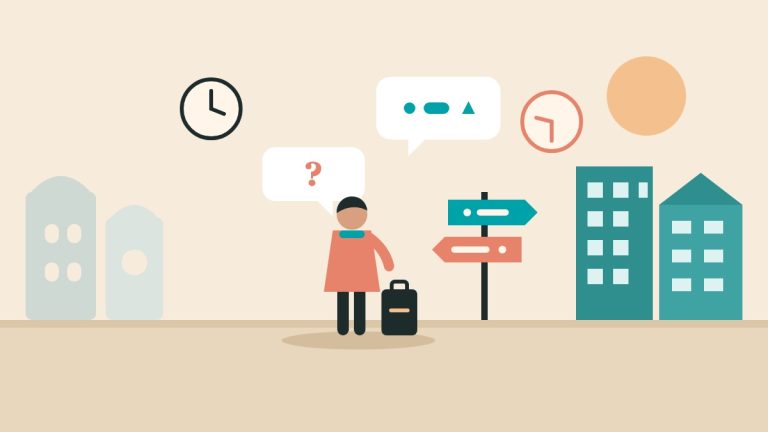
You arrive in a new country full of enthusiasm. In the first few weeks everything seems interesting: the food, the streets, the way people talk. Then one day, almost without noticing, what used to seem curious starts to wear you out. You don’t understand why people react the way they do, you feel clumsy in situations you handled without thinking back home, and you miss things you never used to value.
That has a name: culture shock. It is one of the most common experiences of living abroad, and understanding how it works helps a lot in getting through it.
What is culture shock?
The term was popularised by anthropologist Kalervo Oberg in 1960. He described it as the anxiety that appears when you suddenly lose all the familiar signs and symbols you used to find your way in daily life: how people greet each other, when they eat, what a silence means, how to ask for something in a shop or an office.
In your own country, those rules are invisible: you learned them as a child and apply them without thinking. When you change culture, suddenly you have to think about everything. And that is exhausting.
Today, cross-cultural psychology does not see it as an “illness”, but as a learning process: your mind is adapting to an environment with different codes. It is normal, temporary in most cases, and it can be supported.
The stages of culture shock
The best-known model is the U-curve, proposed by Sverre Lysgaard in 1955 and taken up by Oberg:
- Honeymoon: enthusiasm, curiosity, everything is new and exciting.
- Crisis: frustration, tiredness, irritation or sadness appear. The differences are no longer amusing.
- Adjustment: you start to understand the rules, build routines and feel more competent.
- Adaptation: you move comfortably between the two cultures, and the country starts to feel partly like yours.
That said, research has added a lot of nuance to this model. A longitudinal study by Colleen Ward and colleagues (1998) found that, for many people, difficulties are greatest at the start and then decrease, with no prior “honeymoon”. Not everyone goes through every stage, or in the same order. The curve helps you understand that the dip is common, not to measure whether you are doing “well” or “badly”.
Two kinds of adjustment
Research by Ward and her team distinguishes two dimensions that don’t always go together:
- Psychological adjustment: how you feel. Your mood, your stress level, your wellbeing.
- Sociocultural adjustment: how you cope. Speaking the language, understanding paperwork, making friends, knowing how to behave at work.
You can manage very well on a practical level and still feel lonely or sad. Or the other way round: be in good spirits but still lost with social codes. That is why it is worth looking at both.
Signs you are experiencing culture shock
- Constant tiredness, even without doing “anything special”: your brain is translating and decoding all day long.
- Irritability with local people or their customs, and constant comparisons with “how we do it back home”.
- Intense homesickness and wanting to spend time only with people from your own country.
- Feeling clumsy or incompetent, especially if you felt confident in your own country.
- Anxiety about social situations, phone calls or paperwork.
- Changes in sleep or appetite, headaches or muscle tension.
- Doubts about your decision: “what am I doing here?”, “did I make a mistake?”.
What makes it more intense?
Not everyone experiences it in the same way. Research highlights several factors:
- Cultural distance: the more different the two cultures, the more there is to learn.
- Language: not being able to express yourself with nuance and humour affects your self-esteem and your relationships.
- Social support: one of the most important protective factors. Having someone to talk to makes a big difference.
- Expectations: if you expected everything to be easy or similar to home, the contrast hurts more.
- Whether or not the move was your choice, and whether you have a clear project (work, studies, partner).
Psychologist John Berry also described four ways of positioning yourself between two cultures: integration (keeping your identity while taking part in the new society), assimilation, separation and marginalisation. Studies link integration with better long-term wellbeing. It is not about ceasing to be who you are, but about adding to it.
Culture shock, migratory grief and Ulysses syndrome
These concepts are related, but not the same:
- Culture shock focuses on the confusion caused by different codes and customs, especially at the beginning.
- Migratory grief refers to everything you lose when you emigrate (family, language, status, land) and how you work through it over time.
- Ulysses syndrome describes extreme, chronic stress when the conditions of migration are very harsh: forced loneliness, fear, the struggle to survive.
Many people experience culture shock and migratory grief at the same time. Naming them helps you understand what is happening and stop blaming yourself for it.
Reverse culture shock: when you go back
Returning to your own country can be unsettling too. In 1963, psychologists John and Jeanne Gullahorn extended the U-curve into a W-curve: after adapting abroad, a second dip can appear when you return. You have changed, your country has too, and sometimes you feel you no longer quite fit in anywhere. It is more common than people think and often catches people by surprise, precisely because nobody expects to feel like a foreigner at home.
What you can do
- Normalise what you feel: tiredness and irritation are part of the process; they don’t mean you made a mistake.
- Observe instead of judging: when something jars, try asking yourself “what sense does this make here?” before thinking “this is wrong”.
- Build a small network: a class, a club, volunteering. Something weekly that lets you see the same people again.
- Combine both cultures: keep what does you good from your own (food, music, calls home) and make room for the new.
- Invest in the language, even little by little: every step forward gives you autonomy and confidence.
- Look after the basics: sleep, exercise and stable routines help your body stop living on alert.
- Give yourself time: adjusting takes months, sometimes years. Don’t compare your day 100 with someone else’s day 1,000.
When to ask for help, and how therapy can help
It is worth seeing a professional if your distress lasts several months without improving, if you are becoming more and more isolated, if anxiety or sadness is affecting your work or your relationship, or if you are thinking of going back mainly to stop feeling this way.
In therapy we work on, among other things:
- A clear assessment of what is happening: culture shock, migratory grief, anxiety, or a mix of all three.
- Cognitive behavioural therapy (CBT) tools to manage anxiety, constant comparisons and avoidance of new situations.
- Third-wave CBT (Acceptance and Commitment Therapy and mindfulness) to make room for homesickness without letting it paralyse you, and move towards what matters to you.
- Your own balance between the two cultures, without giving up who you are.
I have lived and worked in Spain, France, England, South Africa and Ethiopia myself, so I know from the inside what it means to start from scratch far from home. Sessions take place by video call and in English, wherever you are.
Frequently asked questions
How long does culture shock last?
There is no fixed length. For many people, the most intense part happens in the first months and eases as they understand the codes and build a network. If after a year you still feel the same or worse, it is worth asking for help.
Is it normal to experience it even though I chose to move?
Yes. A change being wanted doesn’t stop it from being stressful. You can be happy with your decision and, at the same time, worn out by adjusting.
Does it affect people who move as a couple in the same way?
Not always. It is common for one partner to adapt faster, for example the one with a job and colleagues, while the other feels lonelier. Talking about it early prevents a lot of conflict.
Can online therapy help with this?
Yes. For many people living abroad, it is the easiest way to talk to a psychologist in their own language, and video sessions allow good-quality work.
Shall we talk?
If you recognised yourself in this article, you don’t have to go through this alone. The first contact is free and lasts 20 minutes: you tell me what is going on and we see together how I can help.
Free first contact · Message me on WhatsApp
Gonzalo Garzo, clinical psychologist (registered in France, ADELI 179307913, and with the Official College of Psychologists of Madrid, M-34763), specialising in expatriation and adjustment processes.
Sources
- Berry, J. W. (1997). Immigration, acculturation, and adaptation. Applied Psychology, 46(1), 5–34.
- Gullahorn, J. T. & Gullahorn, J. E. (1963). An extension of the U-curve hypothesis. Journal of Social Issues, 19(3), 33–47.
- Lysgaard, S. (1955). Adjustment in a foreign society: Norwegian Fulbright grantees visiting the United States. International Social Science Bulletin, 7, 45–51.
- Oberg, K. (1960). Cultural shock: Adjustment to new cultural environments. Practical Anthropology, 7, 177–182.
- Searle, W. & Ward, C. (1990). The prediction of psychological and sociocultural adjustment during cross-cultural transitions. International Journal of Intercultural Relations, 14(4), 449–464.
- Ward, C., Bochner, S. & Furnham, A. (2001). The psychology of culture shock (2nd ed.). Routledge.
- Ward, C., Okura, Y., Kennedy, A. & Kojima, T. (1998). The U-curve on trial: A longitudinal study of psychological and sociocultural adjustment during cross-cultural transition. International Journal of Intercultural Relations, 22(3), 277–291.